
Regulatory and Procurement Frameworks
This is the fourth and final paper in Pascall+Watson’s four-part insight series on Circular Economy in Transport Infrastructure, drawn from the Interchange 2026 Roundtable. The series has explored the foundational principles of the circular economy, the role of material passports, and the challenges of project delivery. This paper examines the policy, regulatory, and procurement landscape and what must change to move the sector from isolated good practice to systemic transformation.
- – Regulatory and Procurement Frameworks
Good intentions alone will not deliver the circular economy. The principles are understood. The tools are developing. The commercial models are emerging. But without the right policy frameworks, procurement practices, and regulatory conditions, progress will remain fragmented, driven by individual champions rather than systemic change.
This final paper examines the structural changes required to create an environment in which adopting the circular economy in transport infrastructure is the norm rather than the exception.

THE CURRENT LANDSCAPE
The transport infrastructure sector operates within a complex regulatory and procurement environment. Participants were candid in their assessment: the UK’s current policy framework is insufficiently supportive of adopting the circular economy at scale in the infrastructure sector.
The commercial real estate sector has benefited from targeted regulatory interventions, most notably the GLA’s requirement for pre-demolition audits, which has demonstrably shifted practice in London. In transport infrastructure, no equivalent lever currently exists. Government task forces are active but not yet translating into meaningful changes in procurement behaviour or planning requirements. The result is that progress is driven primarily by individual client ambition, which remains inconsistent in the infrastructure sector.
At the same time, participants were clear that the absence of regulation is not a reason for inaction. The most progressive circular economy businesses are those that have identified a commercial opportunity and pursued it on their own initiative, without waiting for government direction. Organisations have significant agency to develop their own circular strategies, and those that do so now will be best positioned when regulatory frameworks inevitably tighten.
“Collaboration: we need all the right people in the room at the start of a project to say ‘how do we do something really defining, that leaves a legacy, creating something for the greater good of our industry and for our clients, society and the environment’? Paul Toyne | Grimshaw
“Everyone in the room should be clear about the value of what their organisations can deliver and project. Instead of competing purely on cost, organisations should compete on the strength of those value propositions, sharing their vision to create greater collective value.”
Carl Waring | Frazer NashWHAT EFFECTIVE POLICY LOOKS LIKE
The European Union’s legislative landscape provides instructive precedents. The end-of-life duty of care legislation, which places responsibility for product recovery back with the manufacturer, has driven significant behavioural change across the sector, incentivising manufacturers to design for durability, repairability, and reuse, because they retain long-term responsibility for what they produce.
In the UK, the WEEE Directive provides a partial equivalent in the electronics sector, but no comparable framework exists for construction materials or infrastructure components. Participants argued that the introduction of equivalent obligations in the built environment, requiring manufacturers and asset owners to take responsibility for the materials they introduce into the built environment, would be transformative.
A policy that creates market signals, rather than simply imposing compliance requirements, was identified as the most effective approach. When a regulatory requirement drives genuine demand for circular solutions, it creates the conditions for commercial investment in the supply chain capabilities, skills, and technologies that are currently underdeveloped.

PROCUREMENT AS A STRATEGIC LEVER
The procurement discussion was among the most animated of the entire roundtable, and with good reason. Procurement is one of the most powerful levers for driving circular-economy adoption at scale. But only when it is used strategically.
When a major infrastructure programme commits, early in its development, to specific circular economy outcomes, it sends a market signal that can catalyse investment in new capabilities, supply chains, and business models across the sector. Conversely, when procurement is reduced to a cost-driven exercise at the point of contract award, the opportunity to embed whole life value is effectively lost, often irreversibly.
The point was made strongly: circular economy ambitions must be embedded at the business case and environmental impact assessment stage, not introduced at procurement. By the time a contract is being tendered, the boundaries of what is achievable have already been set. Practitioners who can engage at the earliest stages of a project, influencing the brief, the budget, and the evaluation criteria, are in a far stronger position to deliver meaningful outcomes.
“Major infrastructure projects can provide clear market signals. The strategic decisions are being made way, way, way in advance from when any of the materials or products are going to be required.”
Andrea Charlson | The Concrete CentreINFRASTRUCTURE PROJECTS AS CATALYSTS
The debate about project procurement strategies highlighted both the potential and the limitations of current approaches. A programme’s ambition to drive innovation through its supply chain would be widely acknowledged. The concern was that this ambition may not be matched by the strategic coordination needed to translate it into systemic change.
An example opportunity, using a project’s cement procurement volumes to help decarbonise the UK cement manufacturing sector, with benefits cascading into housebuilding and other major programmes, illustrates the kind of joined-up, value-driven procurement thinking that the sector largely lacks. When a programme of that scale aligns its procurement strategy with a broader industrial transformation goal, the potential impact extends far beyond the programme itself. That opportunity needs to be fully realised.
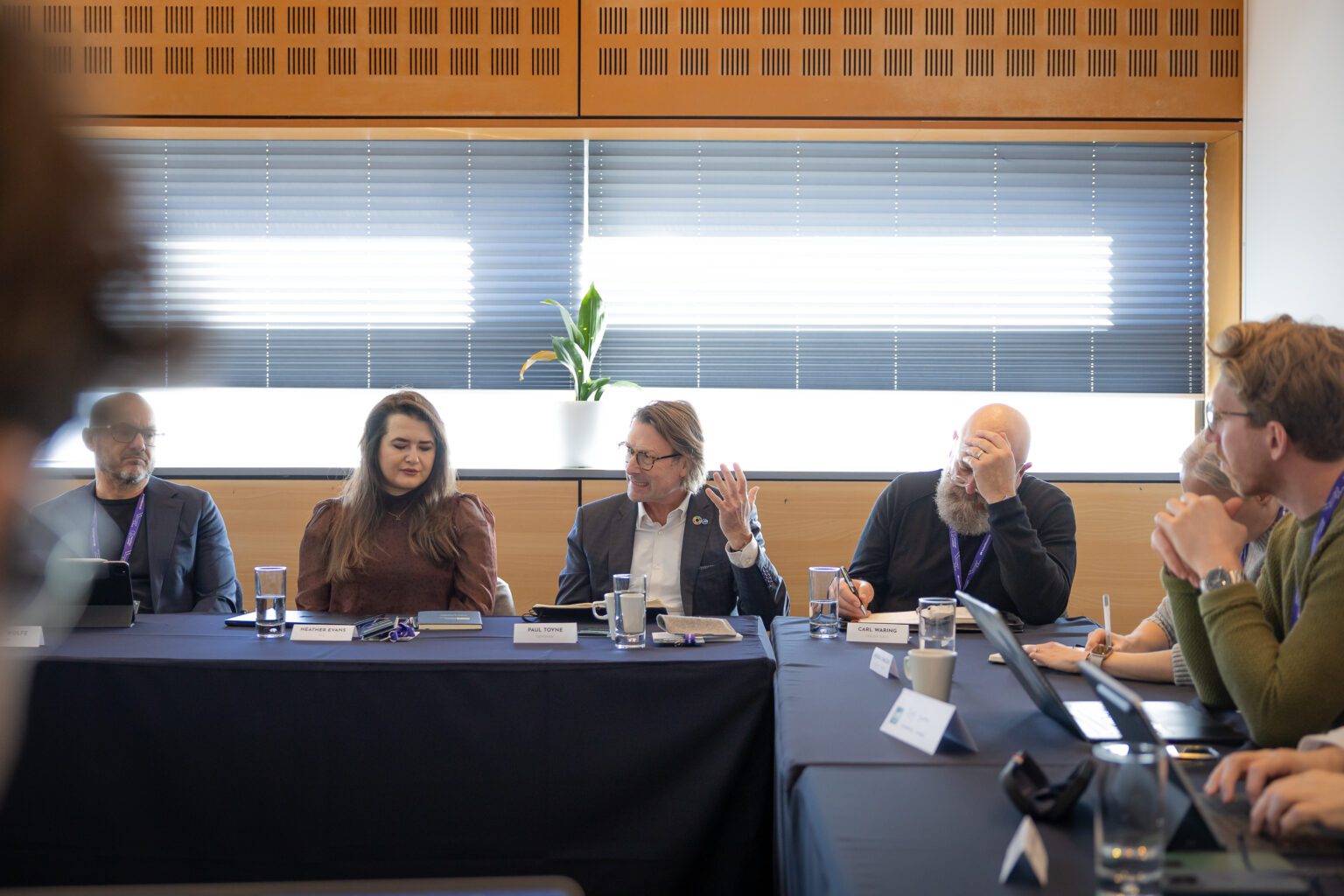
“Say, for example, in concrete, how do we decarbonise the cement sector in the UK? Through procurement strategies in major infrastructure projects we could send the demand signal to the market – we want low carbon cement. The manufacturers can then respond and use this use this demand to invest in low carbon cement production for these projects and for other sectors like house building”
Paul Toyne | GrimshawRISK, LIABILITY AND TAKE-BACK MODELS
The session concluded with a grounded, practical examination of how risk and liability are managed in circular commercial models, drawing on live examples from product suppliers operating active take-back and remanufacturing programmes.
Participants described programmes in which products are recovered, assessed, refurbished, and reinstated, in some cases with warranties covering the full remaining operational lifetime of the asset in which they are installed. These examples are significant not just as demonstrations of circular economy practice, but as evidence of something more fundamental: that circular economy models can work commercially. Reusing an existing product and extending its life through maintenance and refurbishment saves costs and reduces carbon emissions.
There is no conflict between commercial accountability and environmental responsibility in these arrangements. They are perfectly aligned. The implication is clear: the perceived tension between circularity and commercial viability is often a matter of perception, not a structural reality.
The development of a broader ecosystem of specialist trade partners, businesses that focus on specific product categories, process them to the required standard, and return them to the market, was identified as a critical condition for scaling these models across the infrastructure sector.

“We're working with industry partners currently on a project that's in a live situation in central London. It's not just hearsay, it's happening. We're revisiting a 10-year-old install of our mirror system and vanities, and re-purposing them in another area in the same building to help with carbon footprint, so nothing is going off-site. This will not only be cost-effective, but also, we give it a new lifetime warranty following a refurbishment and service of the existing products. This scheme comes under the banner of S3 by Dolphin.” Craig Holding | Dolphin Solutions
“We're launching the SAS Recover, and that's take back, reuse, and reinstate system that we're doing. So, we've got about 3,000,000 square metres of ceiling or metal and aluminium products on infrastructure projects across the UK. It's an opportunity to take that back and give it a new life.”
John Porter | SASCHAIRS |
|
|
| Nimit Raval | Pascall+Watson | Associate: Sustainability |
| Eamon Nolan | Pascall+Watson | Project Director |
PARTICIPANTS |
|
|
| Phanos Hadjikyriakou | 2050 Materials | Co-Founder & CEO |
| Paul Thompson | Assa Abloy | Head of Specification |
| Georgina Chamberlain | Buro Happold | Associate Director |
| Andrea Charlson | Concrete Centre | Senior Sustainability Specialist & Circular Economy Lead |
| Craig Holding | Dolphin Solutions | Client Relations Executive |
| Carl Waring | Frazer Nash | Principal Consultant |
| Paul Toyne | Grimshaw | Head of Sustainability |
| Rob Smith | Material Index | Managing Director |
| Julian Maynard | Maynard Design | Managing Director |
| Heather Evans | RLB | Partner – National Head of Sustainability |
| John Porter | SAS | Sector Development Manager |
| Anthony Arkle | Skanska | Head of Public Affairs |
| Neil O’Sullivan | Shay Murtagh | Group Business Development Manager |
| Mark Wolfe | WSP | Director, Aviation |
IMAGES & PLANNING |
|
|
| Alberto Roa | Pascall+Watson | Marketing Manager |
| Kazz Kumar Williams | Pascall+Watson | Marketing Manager |